Grandstand or Touchline: Two Ways to Watch
Grandstand or touchline: compare the broad view with the ground-level view to choose where to watch and notice how play, space and people connect.
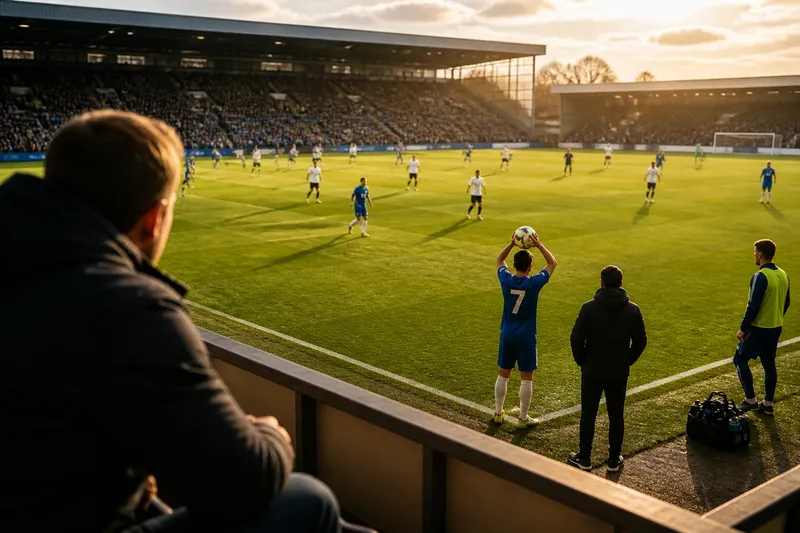
From a grandstand, a match opens like a map: players shift across the pitch, and gaps appear before the ball reaches them. At the touchline, a scuffed pass, a shouted name and a player checking a shoulder arrive at nearly the same height as your eyes. Grandstand or touchline is not simply a choice between comfort and closeness; each position makes a different part of the game legible.
The stand’s wide frame
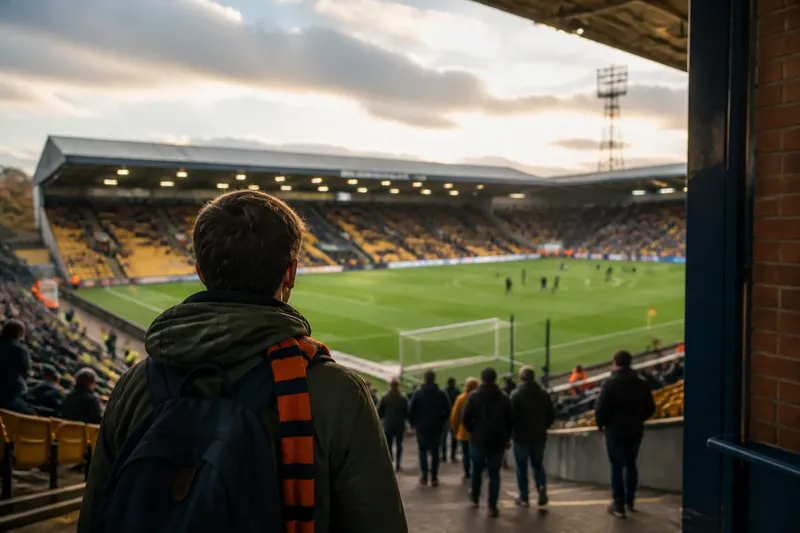
Height makes patterns easier to read. From above, you can follow how a team stretches the field, where a defensive line holds, and which areas are left unattended when play moves elsewhere. The ball may be small, but the shape around it is unusually clear.
That broad view also reveals the match as a set of relationships. A winger’s run may draw a defender away; a midfielder may move into the space that opens. From ground level, those motions can look like separate errands. In the stand, they connect.
Choose a seat with a clear view of both touchlines if you want to follow team shape rather than one player. A position near the halfway line often makes the two sides easier to compare, while a seat behind a goal gives a more direct view of attacks approaching that end. The trade-off is straightforward: one view favours the whole field, the other gives one direction more emphasis.
The touchline’s detail
At ground level, the match has texture. You can see a player’s posture before receiving the ball, the small adjustment of feet before a challenge, or the way a substitute watches the action from the sideline. These details are easy to miss when your eyes are tracking the wider formation.
Sound changes the picture too. A call from a teammate can explain a sudden turn; the thud of a clearance makes the ball’s pace easier to feel. The words may be indistinct, but the timing tells you something: communication often begins before the play is obvious to spectators.
The near side can make a short passage of play feel unusually immediate. A throw-in, a contested ball or a player waiting to take a corner happens close enough to notice gestures that vanish from higher seats. The far side, meanwhile, may seem compressed. Like reading a map with your finger covering one street, closeness clarifies one area while obscuring another.
Distance and attention
Each position quietly directs your attention. In the stand, your gaze can follow the ball and then move outward to the players preparing for the next phase. At the touchline, nearby action tends to claim the eye first. Watching well from close range can mean deliberately looking away from the ball for a moment.
Try noticing what happens just before possession changes. From above, look for a player closing a passing lane or a teammate positioning for a second ball. From the edge of play, watch the receiver’s body angle and the nearest opponent’s first step. The same transition offers two different clues about how it began.
Neither vantage point supplies a complete account. A grandstand can make individual skill seem abstract; a touchline can make a team’s overall plan difficult to see. Moving your attention matters as much as changing your seat, though your surroundings set the limits.
Choosing a view?
Which seat helps read team shape?
A higher, central position usually makes spacing and movement across the full field easier to follow. If your interest is how players create or close space, favour that broad view over a seat focused on one end.
What does the touchline reveal?
It brings nearby technique, gestures and communication into sharper view. It is especially useful when you want to watch how a player prepares for a pass or reacts under pressure, rather than track the entire formation.
Can a low seat follow the far side?
Yes, but distant action may be harder to read, particularly when players overlap in your line of sight. A seat with an unobstructed angle helps; patience helps too, since the far side often becomes clearer when play moves into open space.
Is one view better for a first-time watcher?
A raised seat can make the basic movement of both teams easier to understand. Someone more interested in the pace and close details of play may prefer the edge of the field, provided the view is not blocked.
A small viewing exercise
Say you are in a stand and notice that an opponent’s fullback keeps stepping forward when your team has the ball. For the next attack, watch whether a teammate moves into the space behind that player, rather than following only the ball. The expected observable result is a clearer sense of why a pass goes wide or why a forward runs into a particular channel.
At the touchline, try the same exercise with a different cue: watch the nearest defender’s feet as a receiver approaches. A planted stance, a retreating step or a turn toward the sideline can suggest what route is being offered. Treat that as a clue, not a prediction; the match can change direction before your theory has settled in.
Make the position work
Before settling in, check what your actual sightline allows. A railing, an advertising board, a nearby support or the angle of the field can matter more than the general label of “stand” or “touchline.” If you are attending a venue with assigned areas or access rules, follow its guidance and any relevant local requirements.
Then choose one thing to watch for a spell: spacing, a particular role, communication, or the movement just before a pass. Switching the subject of your attention can make a familiar fixture feel newly detailed without requiring a better seat.
Grandstand or touchline comes down to which evidence you want most: the pattern made by many players, or the small decisions made within reach of the sideline. If the view is fixed, borrow the other perspective with your attention. From a high seat, look for a player’s first touch; from the edge, glance across the field when play pauses. The game is larger than any one seat, though some seats make particular parts easier to see.