From Match Programme to Pocket Archive
A match programme can preserve more than the score. Learn how to read, mark and store its small details as a record of one particular day.
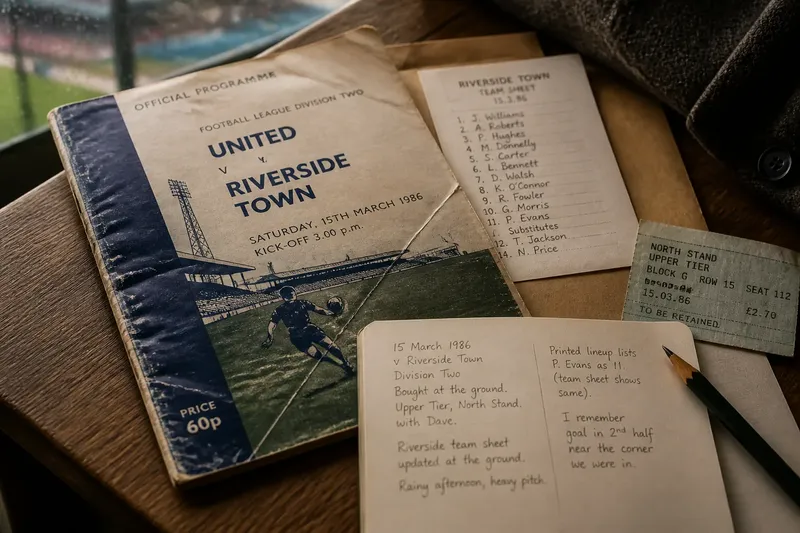
The programme is already softening at the corners when you tuck it into your coat after the match. It has the teams, the date and perhaps the score, but the crease across its cover belongs to that afternoon too. A match programme becomes a pocket archive when you keep its printed record together with a few careful notes about what the page cannot say.
This is less a project in collecting than a way to preserve a particular day without turning a souvenir into a museum object. Start with the programme in front of you, keep your additions modest, and make choices that suit the paper you have. The aim is to let future-you recognize the occasion, not to reconstruct every minute.
Choose the programme
Begin with the copy that was actually present at the match, if you have one. A programme bought at the ground carries useful context in its cover, price mark, insert, or the way it was handled; a clean replacement can still serve, but it is a different kind of object. Do not discard a loose ticket or folded team sheet just because it looks untidy.
Before writing anything, look through the whole item once. Note what is already printed: venue, fixture, competition, date, team names, squad lists, advertisements, editorial notes, and any handwritten changes. These details may seem routine while the match is fresh. Later, they can be more evocative than a scoreline.
If there are several copies, choose the one with the clearest connection to your attendance, not automatically the prettiest. A scuffed cover or a pencil mark can be part of the record. If the programme is borrowed or belongs to someone else, ask before annotating or altering it.
Read its small clues
Move through the pages in their printed order and notice what anchors the fixture in its setting. The cover may show a sponsor, a ground name, a competition, or an illustration that was used only for that occasion. Inside, a squad list can preserve a spelling, shirt number, or selection that the result alone cannot recover.
Look closely at the less prominent material too. A printed kick-off time, a page describing a club initiative, a local business advertisement, or a note about a rearranged fixture can give the day its particular texture. The programme is not a neutral account: its language and selection reflect what the club chose to print. Keep that perspective in mind rather than treating every line as a complete record.
Check for inserts and changes before deciding what belongs with the programme. A loose team sheet may update a printed lineup; a handwritten correction may identify a late change. Keep an insert alongside its original pages, rather than taping it in. Tape and glue can discolor paper or tear it when removed.
Record the day
Write down only what you would otherwise forget. A date and opponent may already appear on the cover; your note can add how you came by the programme, who was with you, which stand or section you sat in, or what you noticed in the ground. A few precise observations are more useful than a running account of the match.
Use a soft pencil on a blank margin or a separate archival note, and avoid writing over printed text. If the paper is thin, brittle, glossy, or already marked, place your notes on a separate sheet instead. Do not use a ballpoint pen, marker, adhesive label, or sticky note directly on the programme; ink can bleed, and adhesives can leave residue.
Keep distinctions clear between what the programme says and what you remember. For example, write “printed lineup lists…” for information on the page and “I remember…” for recollection. That small separation helps a later reader understand which details came from the object and which came from the person who kept it.
Add context carefully
Choose one or two details that make the record legible outside your own memory. The full date matters more than “Saturday”; the opponent matters more than “home game.” If the programme gives only a season or competition, add the missing fixture information on a separate note after checking it against a reliable record you already use. Do not guess at a detail because it feels familiar.
Say you find a programme from a rainy afternoon, with a loose team sheet and a faint mark where it was folded into a pocket. You could note the fixture and date, identify the inserted sheet as a late lineup, and add that you watched from the upper section with a friend. The expected result is a record that distinguishes this afternoon from another match against the same opponent, without pretending that the paper captures everything that happened.
Keep personal context discreet if the programme may be shared or inherited. A first name or brief description can help identify company; a private story need not be written on the object. If the memory depends on a conversation, place, or detail that might be unclear later, record enough to identify it without turning the programme into a diary.
Store it without strain
Once the notes are settled, store the programme flat in a folder or archival sleeve made for paper. Choose a size that does not force the cover to bend, and avoid overfilling a box so that pages are pressed or crushed. A paper folder is like a coat pocket that does not rub: it keeps the object together without asking it to carry extra weight.
Keep it in a dry place away from direct sunlight, radiators, damp walls, and food or drink. Heat, moisture, and light can fade print or weaken paper. If the programme is already fragile, unusually valuable, or showing mold, seek advice from a qualified paper conservator rather than trying to clean or repair it at home.
Store the ticket, insert, and separate note with the programme, but do not fasten them together. A small paper enclosure can keep loose pieces from wandering while allowing each one to be handled on its own. If you use a digital photograph as a backup, name the file with the fixture and date, and keep the physical object as the original rather than treating a phone image as a substitute.
Match programme questions?
Should I write on the programme?
Only if the paper is sturdy, the writing area is blank, and you are comfortable adding a permanent mark. A soft pencil is a restrained choice; for fragile or glossy stock, write on a separate sheet and store it with the programme.
What if the score is missing?
Leave the score blank rather than filling it from uncertain memory. The date, opponent, venue, and your own clear recollection can still identify the occasion; a result can be added later on a separate note if you verify it.
How should I keep a loose team sheet?
Place it in the same folder or sleeve, next to the programme, and note where it came from. Keeping it loose preserves its edges and makes clear that it was an insert rather than part of the original printing.
Can I keep several programmes together?
Yes, if each remains flat and can be removed without pulling against another. Add a simple paper divider or label to identify each fixture, and avoid tightly binding or stacking delicate copies under heavy objects.
Return to the record
When you take the programme out again, read it in the same sequence: cover, printed details, inserts, then your own note. That order keeps the club’s printed account distinct from the memory you added, while allowing both to inform each other. If a detail no longer makes sense, add a dated note on separate paper rather than silently rewriting the original.
A pocket archive does not need to be complete to be useful. For a match programme, the strongest record may be a printed lineup, a loose sheet, and one sentence about where you watched; those are enough to make the day recognizable without asking the paper to become an official history.